Albert Einstein
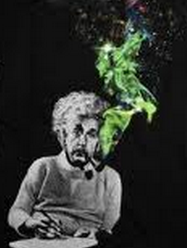
Over Look:
A man who is a mathematician and a physicist, Albert Einsteins theories led to new ways of looking at space, energy, matter and gravity. His work led to very important advances in life. Some of them would be the control of automatic energy, application of light, and space exploration. When he was young and had two Jew parents, his teachers called him lazy, and slow. When he left school at the age of 15, the teachers said there was nothing more they could teach him. Then he went to go study at the institute of Technology in Zurich. He got his PHD in 1905 when he was 26. Also in 1905, he completed 5 groundbreaking scientific papers. He then earned his doctorate, and what he wrote on the 4 out of 5 papers, helped change the way we understand our universe.
A man who is a mathematician and a physicist, Albert Einsteins theories led to new ways of looking at space, energy, matter and gravity. His work led to very important advances in life. Some of them would be the control of automatic energy, application of light, and space exploration. When he was young and had two Jew parents, his teachers called him lazy, and slow. When he left school at the age of 15, the teachers said there was nothing more they could teach him. Then he went to go study at the institute of Technology in Zurich. He got his PHD in 1905 when he was 26. Also in 1905, he completed 5 groundbreaking scientific papers. He then earned his doctorate, and what he wrote on the 4 out of 5 papers, helped change the way we understand our universe.
Childhood
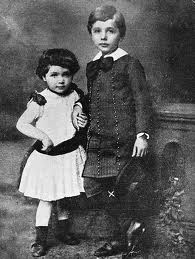
Albert Einstein was born in Ulm, Germany in 1879. (1879 - 1955) He was 76 years old when he died.
He was slow at learning to talk. His parents even called a doctor. When he was 5, he got a compass,
that was when he started his interest in science. Of course, like a lot of other people he had to go to
school. His teachers called him lazy and slow. His rebelliousness to authorities got the headmistress
to expel him. He cut classes most of the time and dropped out of high school. Then at the age of 27
he got his remarkable book about the heroes of revetivily.
ACCOMPLISHMENTS!!!
- LIGHT - Einstein's fascination with light began at an early age. When he was 16 years old, he wondered what it would be like to rise a his bike on a beam of light. Almost 10 years later, in 1905 he had what we call his first "Though Experiment" and came up with the special theory of the relativity in which he stated that light is constant, in like the wavelike picture that the scientists of the time had thought it was. Not only that, it is not possible to travel faster the speed of light, 186,000 miles/seconds. Light always travels at the same speed whether it be on the headlight of a train speeding down the tracks, or the light of the lantern shining on the tracks. The light itself, always travels at the same speed.
Einstein gave the explanation for calculation of Avoqadro's number and the size of molecules.
Einstein was the man, who could give a valid explanation to the question, "Why is the sky blue?" in 1910. He put the "crutial opalescence" phenomenon and give explanation regarding the cumulative effect of the scattering of light by each molecule within the atmosphere.
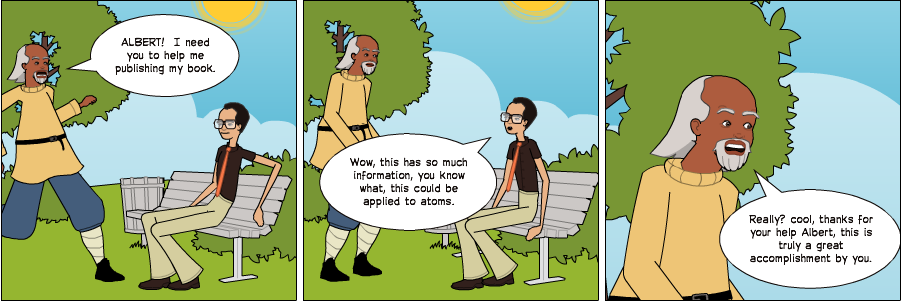
An Indian physicist names Satyendra Nath Bose, sent a short paper to Einstein in 1924. This paper contained information that described light as a gas of photons. He asked Einstein for help in the publication of his paper. Einstein found this theory could be applied to atoms and published the article describing the Bose's model. Today, Bose-Einstein statistics help explain indistinguishable particles called the "bosuns."
An Indian
Einstein gave the explanation for calculation of Avoqadro's number and the size of molecules.
Einstein was the man, who could give a valid explanation to the question, "Why is the sky blue?" in 1910. He put the "crutial opalescence" phenomenon and give explanation regarding the cumulative effect of the scattering of light by each molecule within the atmosphere.
An Indian physicist names Satyendra Nath Bose, sent a short paper to Einstein in 1924. This paper contained information that described light as a gas of photons. He asked Einstein for help in the publication of his paper. Einstein found this theory could be applied to atoms and published the article describing the Bose's model. Today, Bose-Einstein statistics help explain indistinguishable particles called the "bosuns."
An Indian
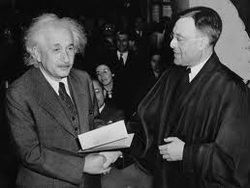
_ Link for where I found his Accomplishments.
_ Link for another picture.
_ Link to the pictures for Einstein.
Page Created by Nicole E. - From Wisconsin. I picked Albert Einstein because he is my role model. He helped make things that if he didn't do, we wouldn't be the same today. I love reading books, also I like doing long term projects.
_ Link for another picture.
_ Link to the pictures for Einstein.
Page Created by Nicole E. - From Wisconsin. I picked Albert Einstein because he is my role model. He helped make things that if he didn't do, we wouldn't be the same today. I love reading books, also I like doing long term projects.
