Daniel Fahrenheit
Weve all had those days when we were disappointed in how healthy we were. You're feeling kinda crummy and wanna stay home. You tell your mom and what does she do? She pulls out the handy dandy thermometer. You use it and as it turns out, you're healthy. You shuffle around cantankerously and get ready for the day. You can thank Daniel Fahrenheit. He was a German scientist who invented what was considered to be the first modern thermometer. In 1714 he made the mercury thermometer and a standardized scale.
Who is Daniel Fahrenheit?
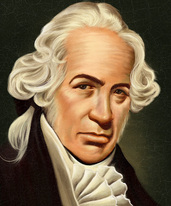
Daniel Fahrenheit was born May 24th, 1686 in Germany. His family was full of merchants. Daniel spent most of his life in the Dutch Republic. His parents died on August 14th, 1701 after eating poisonus mushrooms. After they died, he trained as a merchant in Amsterdam. In1717 Fahrenheit became a glass blower. He made things like barometers, altimeters, and a thermometer. In 1718 he became a lecturer in Chemistry. In 1724 he was elected a Fellow of the Royal Society in England.
What is he known for?
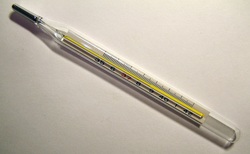
One of the things Daniel is known for is making what is consiterd to be the first modern thermometer. Danish astrominer Ole Roemer made a temperature scale for the use of a alcohol-in-glass thermometer he had made. After visiting Roemer, Daniel decided to make his own. Using mercury instead of alcohol for the expanding liquid, Fahrenheit was able to mark the thermometer with finer divisions, thus, making them more accurate.

To go along with his thermometer, Daniel made a scale. It's known as the Fahrenheit scale. The picture (left) displays both the Celsius and Fahrenheit scale. The Fahrenheit scale is a little different now than it was when it first started. Originally, Fahrenheit had the freezing point of water at 32 degrees. He randomly choose 60 degrees for the boiling point and he said choose 96 degrees as the normal human body temperature. Now, we have something just a little different. We still have the two fixed points of when water freezes and when it boils. It freezes at 32 degrees, that stayed the same, but we figured out that it boils at 212 degrees, not 60. We also raised the normal human body temperature to 98.6 degrees. It's not that much more than what Fahrenheit had originally decided.
Sources
http://inventors.about.com/od/fstartinventions/a/Fahrenheit.htm
http://www.physics.sc.edu/~rjones/phys101/Fahrenheit'sThermometer.html
This page created by Bethany F. I thought this project was cool because people are going to come here for information. This website could be viewed by many people and used often.
http://www.physics.sc.edu/~rjones/phys101/Fahrenheit'sThermometer.html
This page created by Bethany F. I thought this project was cool because people are going to come here for information. This website could be viewed by many people and used often.
