GRACE MURRAY HOPPER
Background Information
Grace Hopper was born as Grace Brewster Murray, on December 9th in 1906. She grew up in New York city as the oldest child in a family of three children. When Grace was a child, she was always curious about how everything worked. It all began when she was seven years old and was wondering how alarm clocks worked. In her process of trying to figure it out, she took apart seven alarm clocks before her mother finally realized why Grace was doing that. Hopper did an early admission for college at Vassar College, at the age of 16, but was rejected because her test scores in Latin weren't high enough. The next year, Hopper was accepted. She got her bachelors degree in 1928 in mathematics and physics. In 1930 Hopper got her masters degree and in 1934 she earned her Ph.D. in mathematics. In 1930, Grace was married to a New York University Professor named Vincent Foster Hopper, but they divorced in 1945. Grace kept Vincent's last name, and never remarried.
Career
Before Grace began work with computers, she was a math teacher for 12 years at Vassar College. When she was 35 years old, she decided to join the war effort. This began her next career, and it was in a new kind of science. Computer Science. After her teacher career, Grace Hopper was not only an American computer scientist, but also a United States Navy rear admiral. One of the first to program the Harvard Mark computer was Hopper. Hopper also created the first compiler. This compiler began the computer programming language. Grace came up with the idea of making programming languages that would be machine-independent. It turned out a great idea, because it led to one of the first modern programming languages to be developed. This modern programming language was created in the spring of 1959 and was named COBOL. It stood for "COmmon Business-Orientated Language" This isn't all Hopper can take credit for, because she also came up with a term for fixing computer glitches, she called it "debugging". A supercomputer at NERSC was named after Hopper, and so was The U.S. Navy Destroyer, "The USS Hopper". A popular nickname for Grace Hopper was "Amazing Grace". Hopper retired in 1986 and lived until January 1, 1992.
Grace Hopper was born as Grace Brewster Murray, on December 9th in 1906. She grew up in New York city as the oldest child in a family of three children. When Grace was a child, she was always curious about how everything worked. It all began when she was seven years old and was wondering how alarm clocks worked. In her process of trying to figure it out, she took apart seven alarm clocks before her mother finally realized why Grace was doing that. Hopper did an early admission for college at Vassar College, at the age of 16, but was rejected because her test scores in Latin weren't high enough. The next year, Hopper was accepted. She got her bachelors degree in 1928 in mathematics and physics. In 1930 Hopper got her masters degree and in 1934 she earned her Ph.D. in mathematics. In 1930, Grace was married to a New York University Professor named Vincent Foster Hopper, but they divorced in 1945. Grace kept Vincent's last name, and never remarried.
Career
Before Grace began work with computers, she was a math teacher for 12 years at Vassar College. When she was 35 years old, she decided to join the war effort. This began her next career, and it was in a new kind of science. Computer Science. After her teacher career, Grace Hopper was not only an American computer scientist, but also a United States Navy rear admiral. One of the first to program the Harvard Mark computer was Hopper. Hopper also created the first compiler. This compiler began the computer programming language. Grace came up with the idea of making programming languages that would be machine-independent. It turned out a great idea, because it led to one of the first modern programming languages to be developed. This modern programming language was created in the spring of 1959 and was named COBOL. It stood for "COmmon Business-Orientated Language" This isn't all Hopper can take credit for, because she also came up with a term for fixing computer glitches, she called it "debugging". A supercomputer at NERSC was named after Hopper, and so was The U.S. Navy Destroyer, "The USS Hopper". A popular nickname for Grace Hopper was "Amazing Grace". Hopper retired in 1986 and lived until January 1, 1992.
PICTURES:
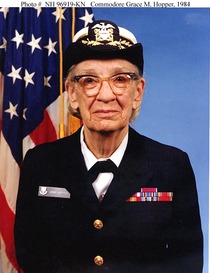
This is Grace Hopper, a computer scientist

Grace Hopper grew up in New York City with a well educated family, such as her Grandfather who was a civil engineer.
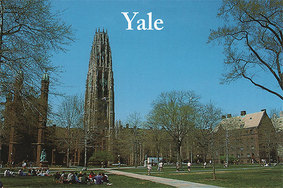
After Graduating Phi Betta Kappa with her bachelors degree, Hopper attended Yale University to receive her masters degree in 1930.
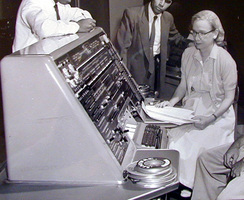
Here is Hopper working on a computer. (As you can tell, it is a very very old computer.)

This is a famous Grace Hopper Quote.
VIDEO
GRACE HOPPER CARTOON
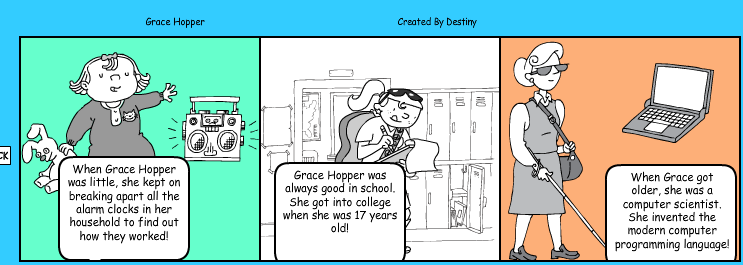
This is a cartoon I made that shows a bit about Grace Hopper's life!
BIBLIOGRAPHY:
Works Sited: (Pictures)
1. http://www.text100-uk.com/wp-content/uploads/2012/10/GraceHopper-and-UNIVAC.jpg
2. http://www.history.navy.mil/photos/images/h96000/h96919k.jpg
3. http://gwynridenhour.files.wordpress.com/2013/12/grace-hopper.jpg
4. http://en-img.hb-assets.com/r20/assets/common/images/destinations/new_york_city.png
6. http://www.nephotoct.com/_images_postcards/Yale001.jpg
2. http://www.history.navy.mil/photos/images/h96000/h96919k.jpg
3. http://gwynridenhour.files.wordpress.com/2013/12/grace-hopper.jpg
4. http://en-img.hb-assets.com/r20/assets/common/images/destinations/new_york_city.png
6. http://www.nephotoct.com/_images_postcards/Yale001.jpg
Works Sited: (Information)
1. Leib, David. "Grace Murray Hopper." math.wichita.edu. N.p.. Web. 29 Dec 2013. <http://www.math.wichita.edu/history/women/hopper.html>.
2. Wikepedia, . "Grace Hopper." Wikepedia. N.p.. Web. 29 Dec 2013. <http://en.wikipedia.org/wiki/Grace_Hopper>.
By Destiny D. I picked Grace Hopper because I had recently heard her name mentioned somewhere so she was the first scientist to pop up in my head.
