Aristotle
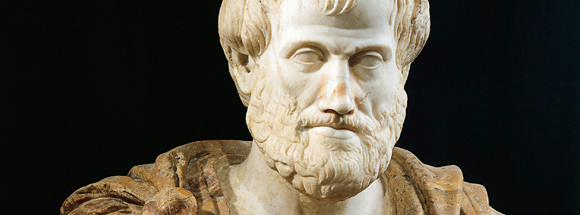
Aristotle
The Life of Aristotle
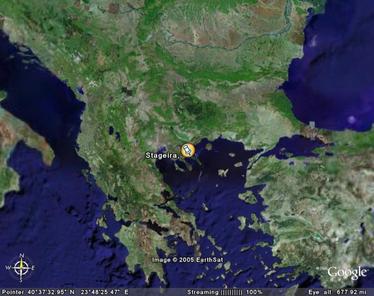 Map of Stageira, Greece.
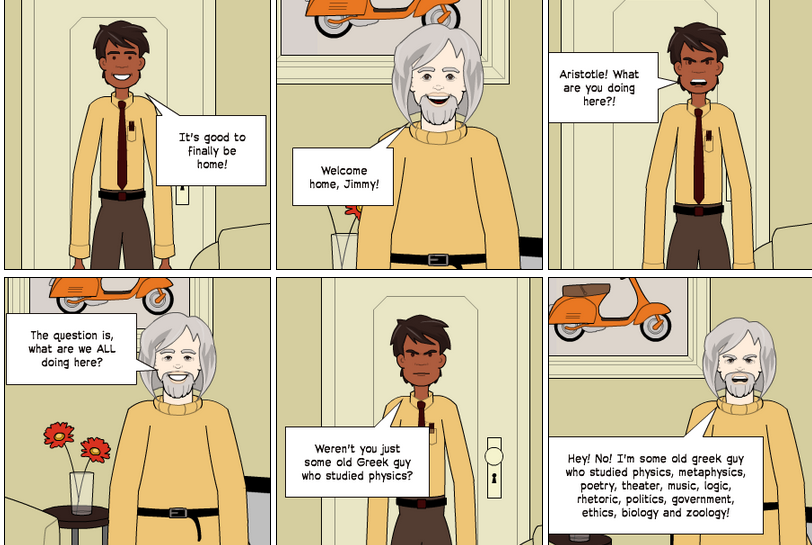
Aristotle was born in 384 BC in Stageira, Greece. Aristotle was the son of Nichomachus. Aristotle was first trained in medicine, but later he was sent to Athens with Plato in 367 to study philosophy. Aristotle was against some of Plato's teachings. When Plato died, Aristotle left Athens and spent time traveling and studying biology in Asia Minor which is now what we call Turkey. Aristotle went to Macedonia in 338 and tutored Alexander the Great. After Aristotle taught Alexander, he went back to Athens and created a school of his own called Lyceum. Aristotle studied in many subjects such as physics, metaphysics, poetry, theater, music, logic, rhetoric, politics, government, ethics, biology and zoology. After Alexander the Great died, Aristotle went against Macedonian rule. Since he didn't want to be put to death, Aristotle left to the island of Euboea. He died soon after in 322 BC in the city of Chalcis, Greece. Aristotle was said to have been one of the smartest people who has ever lived. Many people today believe that no one has ever known more than Aristotle did.
Aristotle Biography
Aristotle's Theories
Although Aristotle never conducted any experiments, he had well known theories and methods. Aristotle's theories were so great, that most of them weren't disagreed with until the last century. Also, his theory had a lot of impact on mid-evil thought. One of his theories was called "Syllogistic Reasoning". This theory was all about the meaning of things. Syllogistic Reasoning is based on many questions like "Why are we here?" and "What does it mean to be?".
Another theory of Aristotle's was, in a way, based on the last theory mentioned. Aristotle divided everything in to four reasons of being. The four reasons were the formal cause, the material cause, the efficient cause and the final cause. He then later divided everything in to a place on a "Ladder". This still has thought on us today. We now refer to this as the "Food Chain".
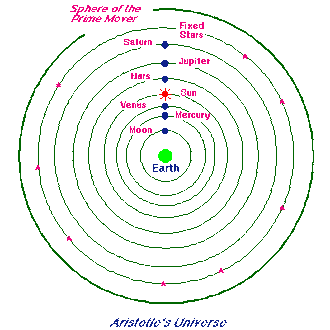
Aristotle's most famous theory is the theory of the universe. Aristotle thought that all of the planets and the sun revolved around the Earth. This was later proved wrong by Galileo Galilei. (1564-1642). Aristotle also thought the the universe was perfect and unchanging. This was proven wrong by Nicolaus Copernicus (1473 - 1543). Copernicus proved this wrong by finding a star in space. When Copernicus found this star, it was dead so that proved how the universe is unchanging.
Another theory of Aristotle's was, in a way, based on the last theory mentioned. Aristotle divided everything in to four reasons of being. The four reasons were the formal cause, the material cause, the efficient cause and the final cause. He then later divided everything in to a place on a "Ladder". This still has thought on us today. We now refer to this as the "Food Chain".
Aristotle's most famous theory is the theory of the universe. Aristotle thought that all of the planets and the sun revolved around the Earth. This was later proved wrong by Galileo Galilei. (1564-1642). Aristotle also thought the the universe was perfect and unchanging. This was proven wrong by Nicolaus Copernicus (1473 - 1543). Copernicus proved this wrong by finding a star in space. When Copernicus found this star, it was dead so that proved how the universe is unchanging.
Works Sited:
Aristotle: http://associatesmind.com/wp-content/uploads/2013/11/aristotle.jpg
Stageira, Greece Map: http://www.awesomestories.com/images/user/5d3f51b9d7.jpg
Aristotle Website http://www.ucmp.berkeley.edu/history/aristotle.html
Website about Aristotle http://www.cod.edu/people/faculty/fancher/Aristotl.htm
Video about Aristotle http://www.youtube.com/watch?v=BeJJpbDrVRM
Aristotle's Universe http://csep10.phys.utk.edu/astr161/lect/retrograde/aristotle.gif
Stageira, Greece Map: http://www.awesomestories.com/images/user/5d3f51b9d7.jpg
Aristotle Website http://www.ucmp.berkeley.edu/history/aristotle.html
Website about Aristotle http://www.cod.edu/people/faculty/fancher/Aristotl.htm
Video about Aristotle http://www.youtube.com/watch?v=BeJJpbDrVRM
Aristotle's Universe http://csep10.phys.utk.edu/astr161/lect/retrograde/aristotle.gif
Page created by Allyssa G. from Wisconsin. I chose Aristotle because he had interesting theories, was very very smart and studied in almost everything.

